German Chancellor Friedrich Merz is visiting Israel for the first time since taking office in May.
His visit comes just days after Germany decided to lift a three-month suspension on arms exports to Israel that it said could be used in the Gaza Strip.
Recommended Stories
list of 3 itemsend of list
Merz, who has said he does not consider Israel’s actions in Gaza to be genocide, is scheduled to meet Israeli Prime Minister Benjamin Netanyahu on Sunday to discuss bilateral relations, the ceasefire in Gaza, and other matters.
Germany is Israel’s second-largest arms supplier after the United States and its fifth-largest export partner, long standing as one of Israel’s staunchest supporters.
Germany’s weapons sales to Israel
According to the Stockholm International Peace Research Institute (SIPRI), between 2019 and 2023, the US was the largest supplier of arms to Israel, providing 69 percent of military equipment, while Germany was the second-largest, supplying about 30 percent. Together, these two countries account for 99 percent of Israel’s arms imports.
In 2023, the German government authorised 308 military export licences to Israel, worth 326.5 million euros ($380m), a tenfold increase from 32.3 million euros ($38m) in 2022.
Since 2003, Germany has sold 3.3 billion euros’ ($3.8bn) worth of arms to Israel, primarily exporting naval equipment, including the Sa’ar 6 corvettes, which were used to attack Gaza and enforce a naval blockade.


Israel also operates German-built Dolphin-class submarines, which are the mainstay of the Israeli Navy’s submarine fleet.
Additionally, Germany has sold a wide range of smaller munitions; the German-built “Matador” shoulder-fired rocket launcher has been used by the Israeli army since 2009, as well as missiles and engines for tanks and other armoured vehicles.
On December 3, Bloomberg reported that Israel will hand over the Arrow 3 long-range anti-ballistic missile defence system to Germany. This transfer grants Germany independent access to this advanced military asset and represents the country’s first major procurement contract following the reassessment of defence capabilities prompted by Russia’s invasion of Ukraine in 2022.
The agreement, which was signed just more than two years ago and constitutes Israel’s largest-ever defence export deal, is valued at more than 3.6 billion euros ($4.2bn), and includes launch systems, munitions and radar.


Why did Germany resume arms exports?
Merz’s August 8 decision to suspend the issuance of weapons export licences to Israel was seen as a significant shift in Germany’s defence policy. At the time, Merz emphasised that Germany could no longer ignore the worsening toll on Gaza civilians while continuing to support what he described as Israel’s “right to defend itself” and the need for the release of captives held by Hamas.
In response, Netanyahu said Germany was rewarding Hamas and failing to adequately support Israel’s “just war”.
On November 24, Germany ended the weapons export restrictions, saying Gaza had now “stabilised” following the ceasefire, but added that the decision was subject to the observance of the ceasefire and the large-scale provision of humanitarian aid.
But Israel’s genocide has not stopped since the ceasefire took effect in October. Israeli attacks have killed at least 360 Palestinians and injured 922, with the Government Media Office in Gaza documenting 591 distinct violations of the ceasefire by Israeli forces. Israel continues to restrict aid, allowing only 20 percent of the mandated trucks into Gaza.
Speaking at the Doha Forum on Saturday, Qatar’s Prime Minister Sheikh Mohammed bin Abdulrahman bin Jassim Al Thani warned that the Gaza ceasefire is at a “critical moment” and could unravel without rapid movement towards a permanent peace deal.
Sheikh Mohammed said what exists on the ground amounts to merely a “pause” in hostilities rather than a genuine ceasefire.


What do Israel and Germany trade most?
Germany is Israel’s fifth-largest export partner and its largest trading partner in Europe, with significant trade exchanges in technology, machinery, and pharmaceuticals. In 2023, Israel sold $2.64bn worth of goods to Germany, primarily in advanced technologies and electronics.
That same year, Germany sold $5.5bn worth of goods to Israel, primarily in machinery and electronics, followed by cars and pharmaceutical products.
Germany actively invests in Israeli technology through venture capital, research and development collaborations, and corporate partnerships with major firms such as Siemens and Bayer.


Germany protests for Israel and Palestine
In the days following the October 7, 2023 attacks, Olaf Scholz, Germany’s former chancellor, became the first leader of a G7 nation to visit Israel, where he emphasised its “right to defend itself”. But UN experts say that Israel, as an occupying power, cannot invoke the “right to defend itself” against Palestinians.
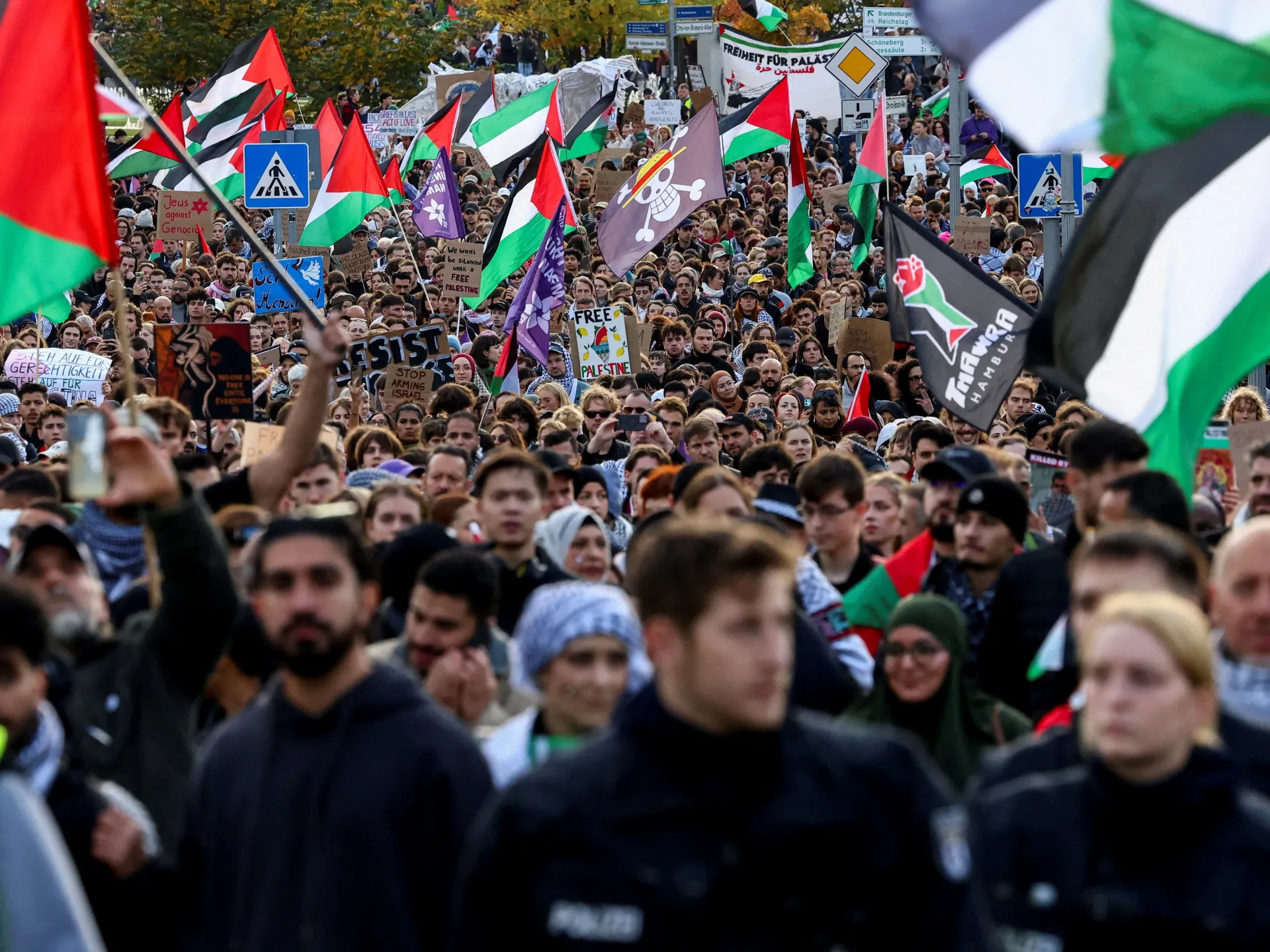
German authorities have cracked down on displays of support for Gaza during the past two years of Israel’s genocidal war. Alongside its political and military backing of Israel, Germany has targeted critics at home, regularly detaining protesters and banning events that support Palestinian rights.
Furthermore, Germany has stated it does not plan to recognise a Palestinian state, unlike 10 European and Western nations that have done so this year.
Since October 2023, there have been 801 Israel-Palestine-related protests in Germany, with 670 supporting Palestine and 131 supporting Israel, according to the Armed Conflict Location & Event Data (ACLED).
The map below shows the locations of these protests.


Germany’s votes on Gaza at the UN
Germany’s support of Israel has often been described as a special relationship. This support stems from its historical context, particularly following World War II and the atrocities of the Holocaust perpetrated by the Nazis.
After the war, the newly formed Federal Republic of Germany sought to confront its past by signing a reparations agreement with the Jewish community in 1952.
At the United Nations General Assembly (UNGA), Germany tends to adopt a cautious voting strategy. It frequently abstains from votes to prevent isolating Israel entirely, while aligning with the international community by voting “yes” on issues that support its commitment to the two-state solution and international law.
There have been at least seven UNGA resolutions concerning Gaza and the broader situation in Palestine since October 2023.
Germany has abstained from three of these resolutions and voted in favour of four.
The graphic below summarises these votes.